
How Environmental Graphics Are Redefining Hospital Experiences
Updated: Mar 31
Walk into a hospital, and before anything else you feel something.
Not the treatment. Not the technology.
But the space.
A patient waiting for answers. A family member searching for a department.
A visitor stepping into an unfamiliar system.
In these moments, people don’t just need medical care they need clarity, calm, and reassurance. And often, the environment determines whether they find it.
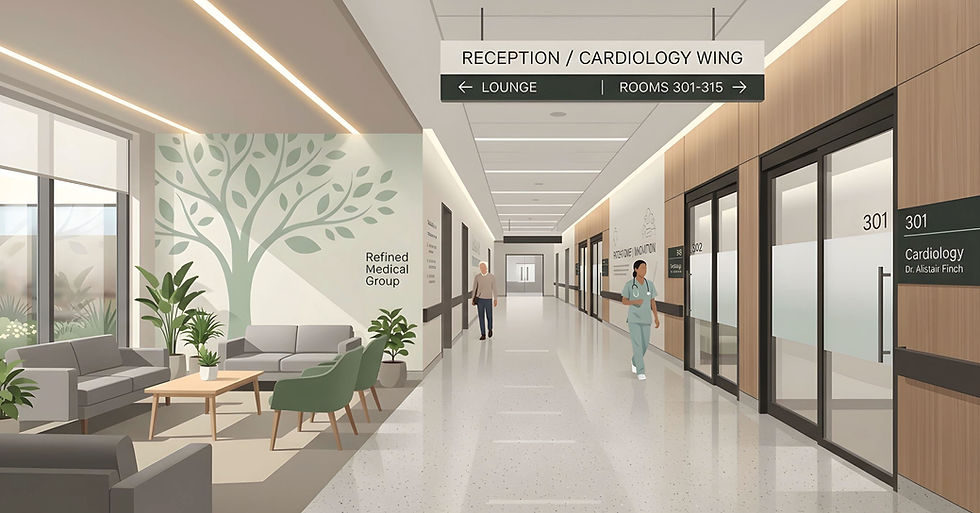
Hospitals Are No Longer Just Functional Spaces
For decades, hospitals were designed for efficiency.
Today, that’s no longer enough.
Healthcare is shifting toward experience-driven environments, where the space itself plays an active role in how people:
Navigate
Feel
Respond
Remember their experience
Because in reality-
People may forget directions… but they never forget how a space made them feel.
When the Environment Fails People
In many hospitals, the experience still looks like this:
Long corridors that feel identical
Signage that’s present, but not helpful
Spaces that feel cold, impersonal, and overwhelming
We’ve seen this across multiple high-movement environments when a space doesn’t communicate clearly, people don’t just get lost.
They feel:
Disoriented
Anxious
Mentally fatigued
And in a hospital, where emotions are already heightened, even small confusion becomes a heavy experience.
When Design Starts to Work With People
Now imagine the opposite.
A space that quietly guides you.
You instinctively know where to go
You don’t have to stop and ask
You feel more in control
This is what environmental graphics do at their best.
They transform hospitals into intuitive systems, where:
Colour coded zones create instant understanding
Clear signage systems reduce hesitation
Visual cues and landmarks guide movement naturally
Good design doesn’t demand attention, it simply removes friction.
The Role of Visual Experience
Navigation solves movement.But what about emotion?
This is where modern hospital design is evolving rapidly, especially through nature-inspired (biophilic) design.
From our experience and global research, even indirect elements like:
Soft, nature-based colour palettes
Organic patterns and textures
Landscape-inspired graphics
can significantly influence how people feel in a space.
They help:
Reduce stress and anxiety
Create a sense of safety
Bring visual comfort into clinical environments
It’s not about decoration. It’s about designing emotional balance into the space.
Turning Environments Into Trust Systems
Hospitals are built on trust.
But trust isn’t created only through medical care it’s reinforced through the environment.
This is where space branding becomes critical.
By creating a consistent visual language across the hospital:
Typography
Colour systems
Messaging
Spatial graphics
the environment begins to feel:
Organized
Reliable
Intentional
And when a space feels intentional, people feel confident in it.
Designing for Real Human Moments
No two hospital spaces should feel the same because no two emotional states are the same.
Environmental graphics allow us to design with empathy:
Pediatric areas → engaging, comforting, less intimidating
Waiting zones → calming, distraction-driven
Recovery spaces → minimal, peaceful, supportive
This is where design moves beyond function and becomes human- centered.
Supporting the System Behind the Scenes
Hospitals are not just patient spaces, they are high-pressure work environments.
Doctors, nurses, and staff interact with the system constantly.
When design works well:
Fewer people ask for directions
Movement becomes smoother
Cognitive load is reduced
In our approach, we see environmental graphics not just as a user tool—but as a system efficiency layer.
Because better environments don’t just improve experience they improve performance.
Designing for the Future of Healthcare
Today’s hospitals are:
Larger
More complex
More experience-driven
Which means the gap between infrastructure and human understanding is growing.
Environmental graphics bridge that gap.
They:
Simplify complex systems
Guide people intuitively
Bring empathy into large-scale environments
And that is why they are no longer optional they are essential.
When Design Becomes Part of Care
At its best, environmental design becomes invisible.
It doesn’t stand out. It supports.
It helps people move without thinking. It makes them feel calmer without noticing.
It builds trust without explaining.
And in a hospital that’s not just good design.
That’s care.
Ready to Transform Your Hospital Experience?
If you're planning a healthcare space or upgrading an existing one, the right environmental graphics system can make the difference between confusion and clarity, stress and calm.
At Chameleon Design, we approach hospital environments as living systems designed to adapt, guide, and support people at every step.
Let’s create a hospital environment that doesn’t just function but truly cares.


